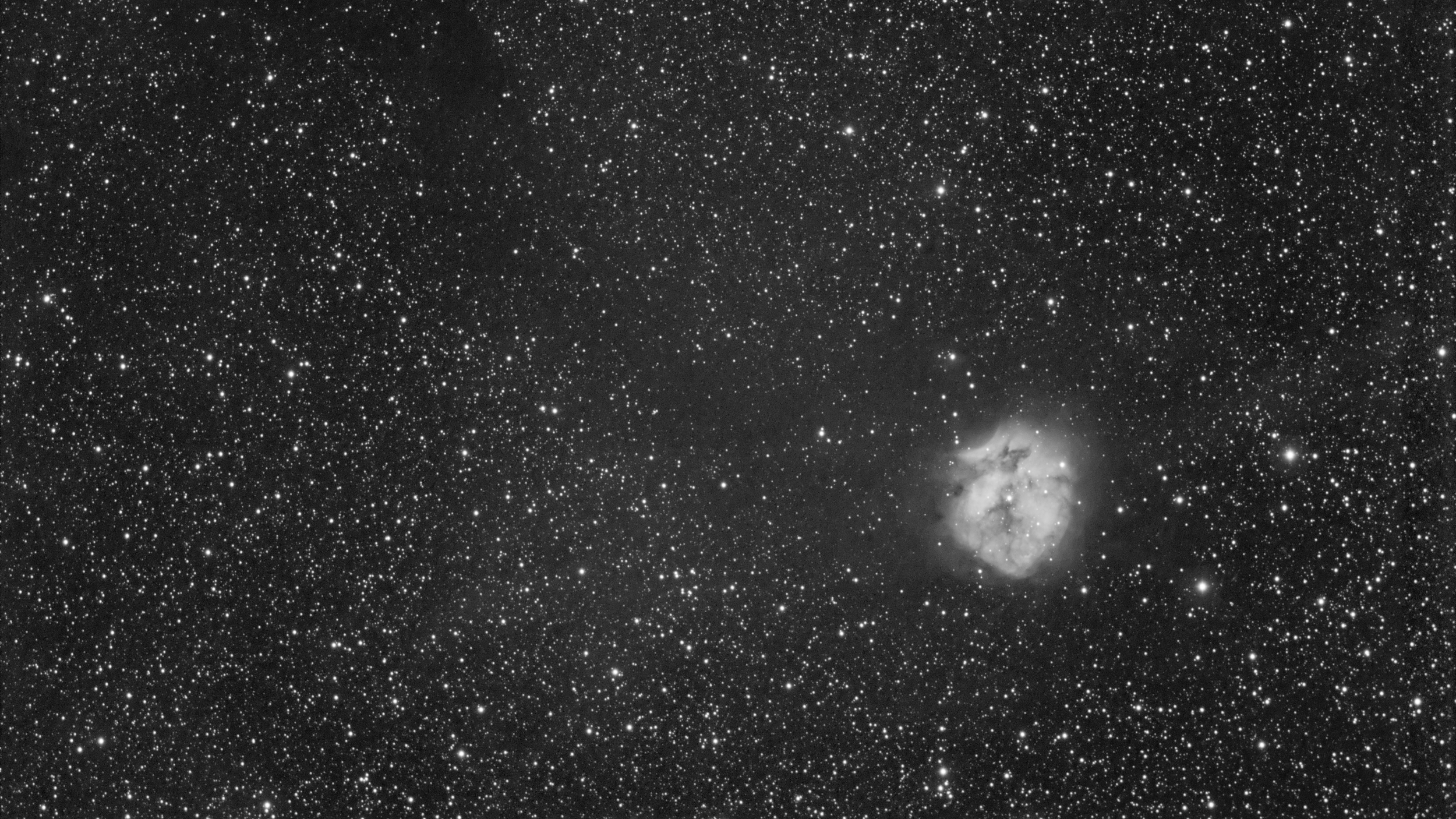
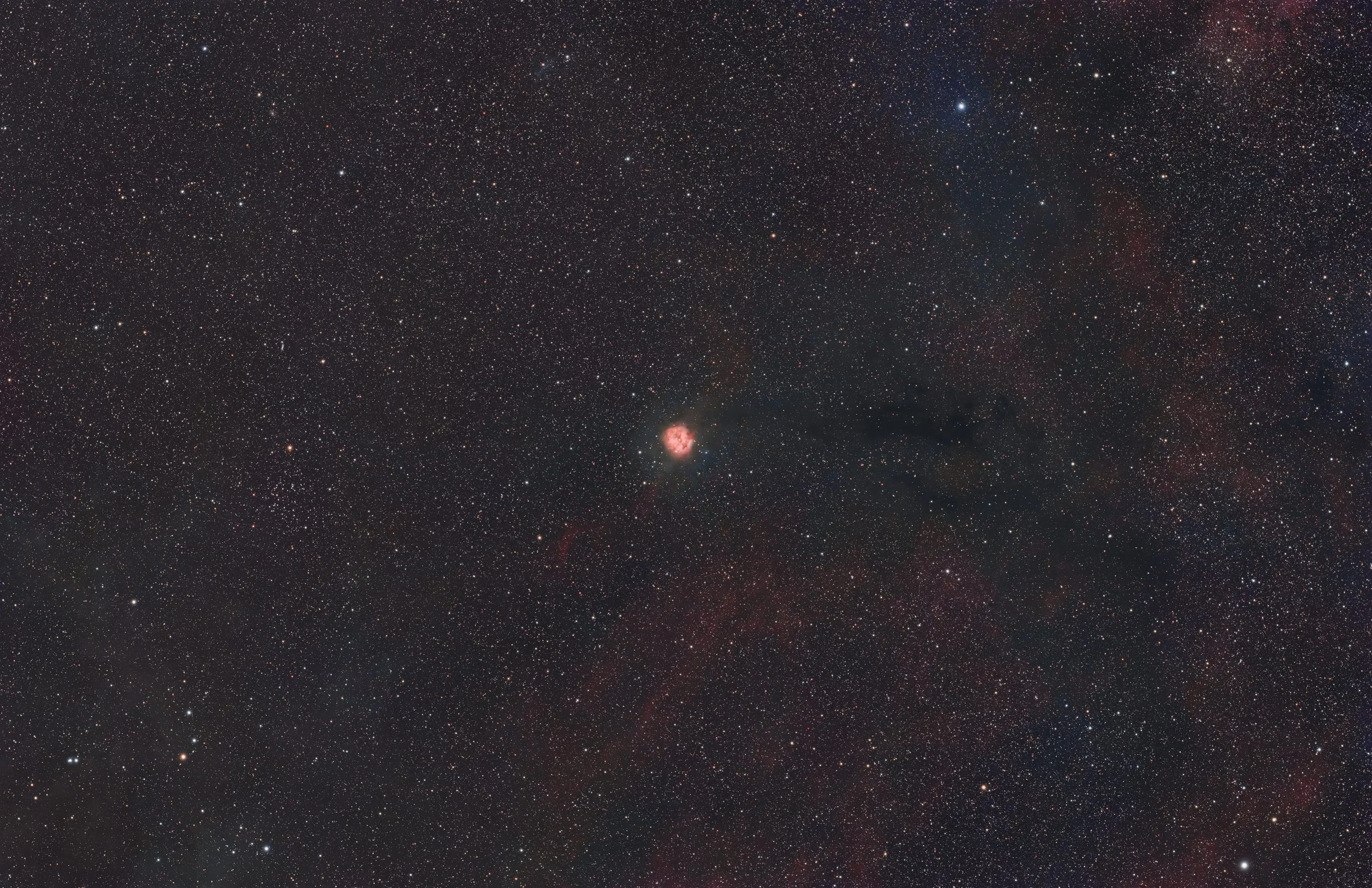
The Cocoon Nebula in Narrowband: 20 Hours Across 4 Clear Nights
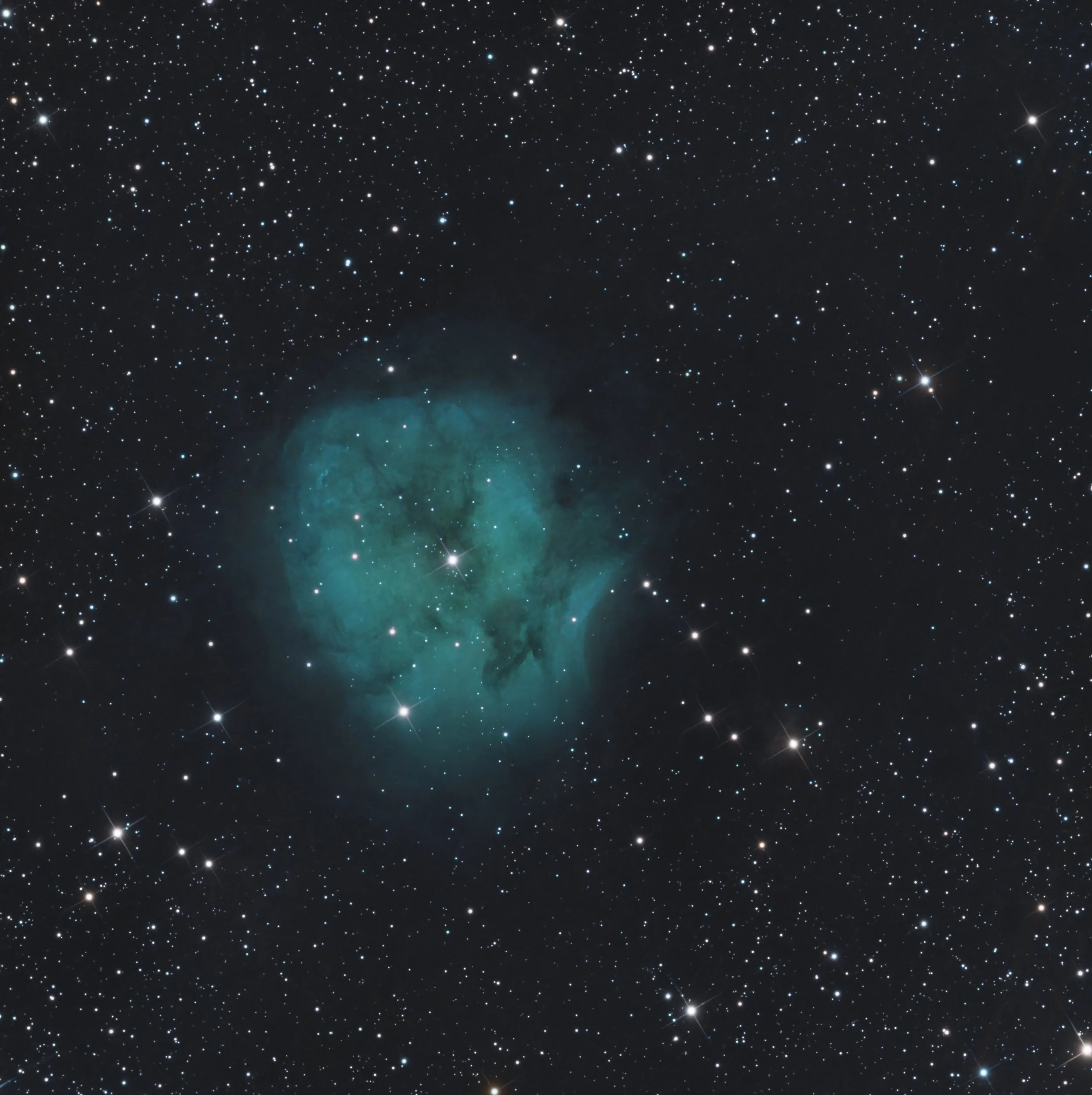
SHOT OVER FOUR EXCEPTIONALLY CLEAR NIGHTS IN MARS HILL, NC, THIS IMAGE OF IC 5146 (THE COCOON NEBULA) COMBINES 18-20 HOURS OF TOTAL INTEGRATION (6-7 HOURS PER CHANNEL IN SHO NARROWBAND), UNVEILING DEEP IONIZED GAS STRUCTURES AND SIGNIFICANT DETAIL AT THE HEAD OF BARNARD 168.
The Cocoon Nebula (IC 5146) is a stellar nursery situated roughly 4,000 light-years away in the constellation Cygnus. While traditionally imaged in broad LRGB to capture its surrounding reflection components and the prominent dark dust lane of Barnard 168, mapped narrowband integration (SHO) reveals a completely different perspective:
Hubble Palette Mapping (SHO): By pushing the integration to 12 hours through each filter ({Sulfur-II Hydrogen-Alpha and Oxygen-III)—totaling 36 hours of exposure—the subtle, high-energy ionized boundaries of oxygen and sulfur come out of the noise floor with incredible clarity.
Acquisition & Optics: Captured using the CarbonStar ricthy f/9 at 1377 F/L imaging setup paired with a QHY533 camera under the my skies of Mars Hill.
Processing: Processed using a workflow in Astro Wizard and PixInsight, leveraging star reduction and precise masking to bring out fine filamentary details while preserving smooth background gradients.
Scientific Significance: The Active Tip of a Dark Filament
Scientifically, IC 5146 is a classic example of an embedded open cluster surrounded by an H II emission region and reflection nebula. At its core lies a massive young star (BD+46°3474) of spectral type B0V, which ionizes the surrounding hydrogen gas and drives out an expanding interstellar bubble.
What makes the Cocoon particularly significant to astrophysicists is its placement at the end of Barnard 168, a long molecular cloud pipe. The Cocoon sits as the active "head" of this dark molecular filament, offering a vivid look at triggered star formation where gravitational collapse along the dense dust channel continuously fuels the creation of protostars and young stellar objects (YSOs).

I’ve been a dedicated to Squarespace fan for 20 years. Love the product, people and company.